Station 5 · Lesson 2
Baseline correction
eeglab_data.set (D1) · Already applied: High-pass & low-pass filtering, Removing line noise (50/60 Hz), Bad channels, Channel interpolation, Re-referencing, Running ICA, 1-Hz filtering for ICA & copying weights, ICLabel & removing components, Extracting epochsDownload the data (opens in a new tab)Script to reach this state
% Shortcut: if you saved D1_main_clean_lp30.set in the ICLabel lesson, keep
% the first line and the last three lines, and replace every line between them with:
% EEG = pop_loadset('D1_main_clean_lp30.set', pwd);
[ALLEEG, EEG, CURRENTSET, ALLCOM] = eeglab;
eeglabRoot = fileparts(which('eeglab'));
EEG = pop_loadset('eeglab_data.set', fullfile(eeglabRoot, 'sample_data'));
fullLocs = EEG.chanlocs;

% Main dataset: high-pass at 0.1 Hz, then 60 Hz line-noise removal
EEG = pop_eegfiltnew(EEG, 'locutoff', 0.1);
EEG = pop_eegfiltnew(EEG, 'locutoff', 58, 'hicutoff', 62, 'revfilt', 1);

% Bad channels you removed earlier, e.g. {'T7'}; leave empty if none
badChans = {};
if ~isempty(badChans)
    EEG = pop_select(EEG, 'rmchannel', badChans);
    EEG = pop_interp(EEG, fullLocs, 'spherical');
end

% Average reference, EOG channels excluded
eogIdx = find(ismember({EEG.chanlocs.labels}, {'EOG1', 'EOG2'}));
EEG = pop_reref(EEG, [], 'exclude', eogIdx);

% ICA on a 1-Hz copy, then copy the weights back
EEG_ica = pop_eegfiltnew(EEG, 'locutoff', 1);
EEG_ica = pop_runica(EEG_ica, 'icatype', 'runica', 'extended', 1);
EEG.icaweights  = EEG_ica.icaweights;
EEG.icasphere   = EEG_ica.icasphere;
EEG.icachansind = EEG_ica.icachansind;
EEG.icawinv     = [];
EEG.icaact      = [];
EEG = eeg_checkset(EEG);

% Remove components ICLabel rates above 90% Eye or Muscle
EEG = pop_iclabel(EEG, 'default');
EEG = pop_icflag(EEG, [NaN NaN; 0.9 1; 0.9 1; NaN NaN; NaN NaN; NaN NaN; NaN NaN]);
artifactComps = find(EEG.reject.gcompreject);
if ~isempty(artifactComps)
    EEG = pop_subcomp(EEG, artifactComps, 0);
end

% Low-pass at 30 Hz
EEG = pop_eegfiltnew(EEG, 'hicutoff', 30);
EEG.setname = 'D1 main clean lp30';

% Epochs around 'square'
EEG = pop_epoch(EEG, {'square'}, [-1 2], 'newname', 'D1 epochs', 'epochinfo', 'yes');
EEG = eeg_checkset(EEG);
EEG.filename = ''; EEG.filepath = ''; EEG.datfile = ''; EEG.saved = 'no';
[ALLEEG, EEG, CURRENTSET] = pop_newset(ALLEEG, EEG, 0, 'setname', 'D1 epochs', 'gui', 'off');
eeglab redraw;
Your browser's back button takes you to the exact place you were, so open anything you like.
The idea in brief
Each epochA short time segment cut out around an event. starts from a slightly different level. The cause is slow drifts left after filteringApplying a filter to the data., or small changes in the electrodeThe physical sensor placed on the scalp to pick up the signal. contact from moment to moment. This offset is not a response to the stimulus, but it is added to every point in the epoch.
Before and after
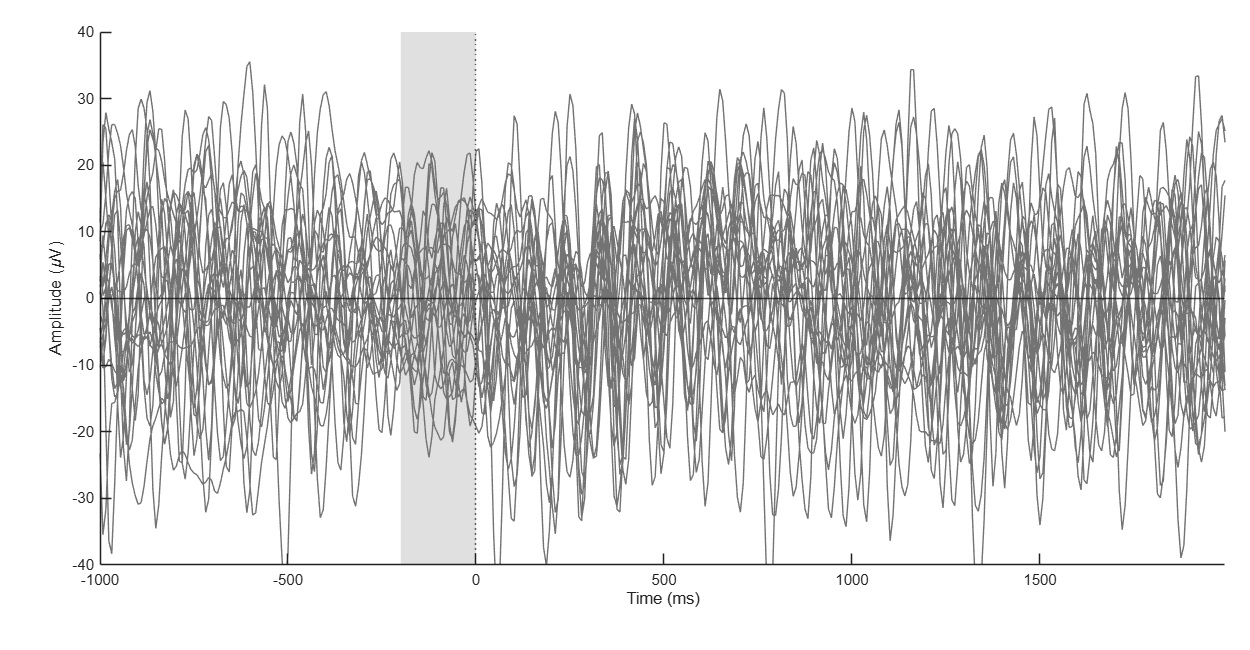
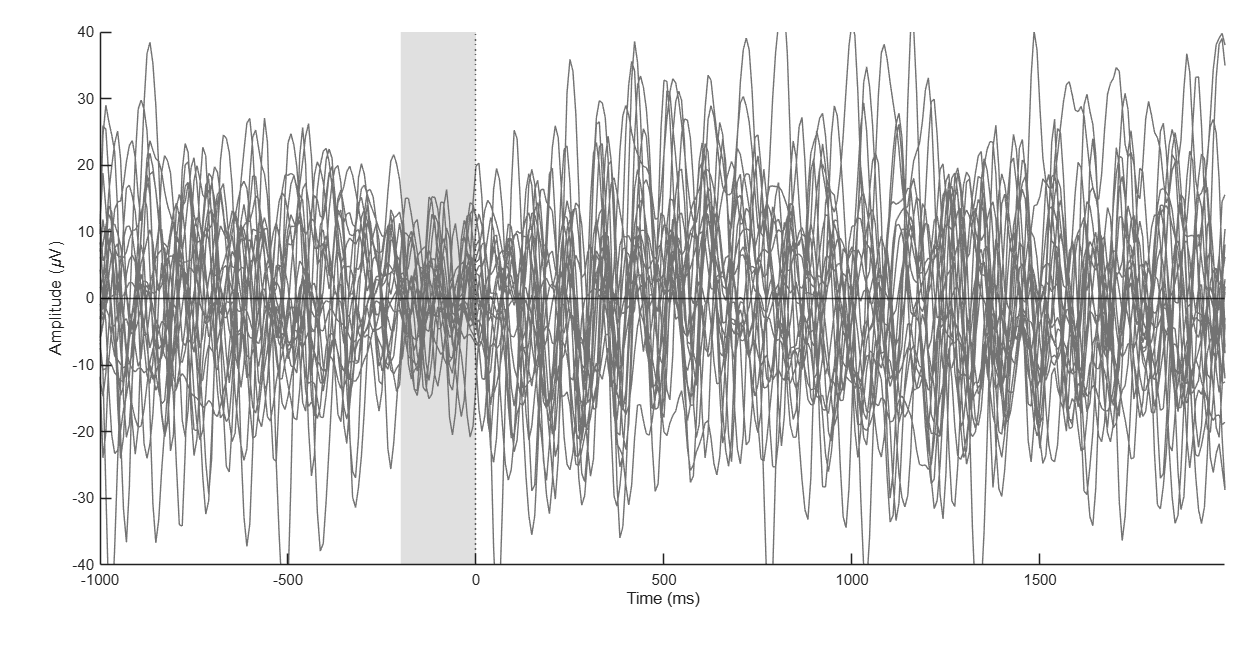
Drag the line to compare.
Your next questions, each answered in its own section:
Why do I need this step?
The reasons in detail, and the terms you need
The fix: take the period before the stimulus, called the baseline, when the participantThe person whose data were recorded in the study. has not seen the stimulus yet. Compute its mean for each channelThe signal recorded from one electrode, as shown in EEGLAB. and each epoch, then subtract that mean from the whole epoch.
After correction, every epoch starts near zero, and any change after the stimulus is measured relative to what came before it.
The high-passA filter that passes high frequencies and weakens slow drifts. filterA tool that weakens some frequencies in a signal and keeps others. in station 3 removed most of the drift, and the official tutorial counts it as a form of baseline correctionSubtracting the mean of the baseline period from each epoch.. But the offsets left between epochs are still enough to affect the average, so baselineThe pre-stimulus period used as the zero level for comparison. correction is a standard step in ERPThe brain's average response to a given event across many trials. analysis.
Why do I need this step?
The fix: take the period before the stimulus, called the baseline, when the participant has not seen the stimulus yet. Compute its mean for each channel and each epoch, then subtract that mean from the whole epoch.
After correction, every epoch starts near zero, and any change after the stimulus is measured relative to what came before it.
The high-pass filter in station 3 removed most of the drift, and the official tutorial counts it as a form of baseline correction. But the offsets left between epochs are still enough to affect the average, so baseline correction is a standard step in ERP analysis.
How do I do it in EEGLAB?
5 steps in the menus
Start with the datasetOne EEG data file loaded in EEGLAB together with its information. D1 epochs open, as in “Starting point”.
- Open Tools then Remove epoch baseline.
- The Baseline removal - pop_rmbase() window opens. In Baseline latency range ([min max] in ms) ([ ] = whole epoch): the default is
-1000 0, the whole pre-eventA marker in the recording that flags a moment of interest, such as a stimulus. period. Change it to-200 0. - Leave Or remove baseline points vector (ex:1:56): empty. It is an alternative that uses point numbers instead of time.
- Leave Channel type(s) and OR channel(s) (default all) empty, so the correction applies to all channels.
- Press Ok. In the new-dataset window, type
D1 epochs blin Name it:, leave Overwrite it in memory (set=yes; unset=create a new dataset) unchecked, then press Ok.
Milliseconds, not seconds
Time in this window is in milliseconds, while the epoch limits in the previous lesson were in seconds. Type -200 0 here, not -0.2 0.
Milliseconds, not seconds
Time in this window is in milliseconds, while the epoch limits in the previous lesson were in seconds. Type -200 0 here, not -0.2 0.
How do I do it in EEGLAB?
Start with the dataset D1 epochs open, as in “Starting point”.
- Open Tools then Remove epoch baseline.
- The Baseline removal - pop_rmbase() window opens. In Baseline latency range ([min max] in ms) ([ ] = whole epoch): the default is
-1000 0, the whole pre-event period. Change it to-200 0. - Leave Or remove baseline points vector (ex:1:56): empty. It is an alternative that uses point numbers instead of time.
- Leave Channel type(s) and OR channel(s) (default all) empty, so the correction applies to all channels.
- Press Ok. In the new-dataset window, type
D1 epochs blin Name it:, leave Overwrite it in memory (set=yes; unset=create a new dataset) unchecked, then press Ok.
Milliseconds, not seconds
Time in this window is in milliseconds, while the epoch limits in the previous lesson were in seconds. Type -200 0 here, not -0.2 0.
Milliseconds, not seconds
Time in this window is in milliseconds, while the epoch limits in the previous lesson were in seconds. Type -200 0 here, not -0.2 0.
How do I write it as code?
The same steps in 8 lines of MATLAB
% Subtract the mean of -200 to 0 ms from every channel and epoch
EEG = pop_rmbase(EEG, [-200 0]);
EEG.setname = 'D1 epochs bl';
EEG = eeg_checkset(EEG);

% Check: the baseline mean should now be close to zero everywhere
blIdx = EEG.times >= -200 & EEG.times <= 0;
blMeans = mean(EEG.data(:, blIdx, :), 2);
fprintf('Baseline points: %d, largest baseline mean: %.2g uV\n', sum(blIdx), max(abs(blMeans(:))));
How do I write it as code?
% Subtract the mean of -200 to 0 ms from every channel and epoch
EEG = pop_rmbase(EEG, [-200 0]);
EEG.setname = 'D1 epochs bl';
EEG = eeg_checkset(EEG);

% Check: the baseline mean should now be close to zero everywhere
blIdx = EEG.times >= -200 & EEG.times <= 0;
blMeans = mean(EEG.data(:, blIdx, :), 2);
fprintf('Baseline points: %d, largest baseline mean: %.2g uV\n', sum(blIdx), max(abs(blMeans(:))));
Which value should I choose?
Suitable values for your analysis goal
| Setting | Value | Why |
|---|---|---|
| Baseline for ERP analysis | -200 to 0 ms | A common value in ERP studies, used for example in the N400 experiment of the ERP CORE data. Short enough to sit close to the stimulus, long enough for a stable mean. |
| The whole pre-event period | -1000 to 0 ms | The default in the EEGLAB window. A more stable mean because it uses more points, but it may include activity from the previous trial when trials are close together. |
| A very short period | 100 ms or less | The official tutorial advises avoiding it when possible, because the mean of few points is noisy. At 128 Hz, 100 ms is only about 13 points. |
| Our path on this site | -200 to 0 ms | 26 points at 128 Hz. The same value for every participant and every condition. |
Rule: choose the baseline period before you see the results, and apply it unchanged to all participants. Changing it after seeing the waveform changes your result.
Which value should I choose?
| Setting | Value | Why |
|---|---|---|
| Baseline for ERP analysis | -200 to 0 ms | A common value in ERP studies, used for example in the N400 experiment of the ERP CORE data. Short enough to sit close to the stimulus, long enough for a stable mean. |
| The whole pre-event period | -1000 to 0 ms | The default in the EEGLAB window. A more stable mean because it uses more points, but it may include activity from the previous trial when trials are close together. |
| A very short period | 100 ms or less | The official tutorial advises avoiding it when possible, because the mean of few points is noisy. At 128 Hz, 100 ms is only about 13 points. |
| Our path on this site | -200 to 0 ms | 26 points at 128 Hz. The same value for every participant and every condition. |
Rule: choose the baseline period before you see the results, and apply it unchanged to all participants. Changing it after seeing the waveform changes your result.
How do I check it worked?
3 quick checks
- Run the check lines at the end of the script: there are 26 baseline points, and the largest mean is very close to zero (below 0.001 µV).
- Open Plot then Channel data (scroll): every epoch starts near the zero line in every channel.
- The number of epochs did not change: Epochs in the main window is still 80.
How do I check it worked?
- Run the check lines at the end of the script: there are 26 baseline points, and the largest mean is very close to zero (below 0.001 µV).
- Open Plot then Channel data (scroll): every epoch starts near the zero line in every channel.
- The number of epochs did not change: Epochs in the main window is still 80.
What mistakes do people make?
5 mistakes and how to avoid them
- Typing the time in seconds. The window expects milliseconds.
-0.2 0means a 0.2-ms period, so only the zero point falls inside it, and the “correction” subtracts the value of a single point. - Keeping the default without thinking. The default here is the whole second before the stimulus. That is not wrong, but it is a decision you should make on purpose and report in your paper.
- A baseline that contains a response. If another event (a button press or an earlier stimulus) falls inside the baseline period, you subtract a real response from the whole epoch. In D1 trials are 3 seconds apart, so -200 to 0 ms is clean. The exception is the second trial: its -1000 to 0 ms period contains the first square, which is one more reason to choose -200.
- A difference before the stimulus. If two conditions already differ during the baseline (for example, a slow wave that starts before the stimulus), correction turns it into a reversed difference after the stimulus. Look at the whole waveform from -200 ms, not only after zero.
- Correcting the baseline before ICA. The official tutorial warns that baseline correction adds random offsets to each channel, which ICA does not handle well. In our path ICA runs before epoching, so this is not a problem.
What mistakes do people make?
- Typing the time in seconds. The window expects milliseconds.
-0.2 0means a 0.2-ms period, so only the zero point falls inside it, and the “correction” subtracts the value of a single point. - Keeping the default without thinking. The default here is the whole second before the stimulus. That is not wrong, but it is a decision you should make on purpose and report in your paper.
- A baseline that contains a response. If another event (a button press or an earlier stimulus) falls inside the baseline period, you subtract a real response from the whole epoch. In D1 trials are 3 seconds apart, so -200 to 0 ms is clean. The exception is the second trial: its -1000 to 0 ms period contains the first square, which is one more reason to choose -200.
- A difference before the stimulus. If two conditions already differ during the baseline (for example, a slow wave that starts before the stimulus), correction turns it into a reversed difference after the stimulus. Look at the whole waveform from -200 ms, not only after zero.
- Correcting the baseline before ICA. The official tutorial warns that baseline correction adds random offsets to each channel, which ICA does not handle well. In our path ICA runs before epoching, so this is not a problem.
Your browser doesn't allow saving progress. All lessons are open, but completion marks won't be saved.
Done. Your progress is saved in this browser.UndoHow do I write it in my paper?
A Methods template: edit the data, settings and versions to match what you ran
A template: edit the data, settings and versions to match what you ran.
Epochs were baseline-corrected by subtracting the mean voltage from -200 to 0 ms before stimulus onset (pop_rmbase, EEGLAB 2026.1).How do I write it in my paper?
A template: edit the data, settings and versions to match what you ran.
Epochs were baseline-corrected by subtracting the mean voltage from -200 to 0 ms before stimulus onset (pop_rmbase, EEGLAB 2026.1).Where can I read more?
3 sources, official docs first
- EEGLAB TutorialDocumentation7. Extract Data Epochs: Removing baseline values
- Applied Event-Related Potential Data Analysis (Luck)2.07 Exercise: Epoching and Baseline Correction
- What is the best ERP baseline?VideoFull video · 16:59
Written for EEGLAB 2026.1 · 2026-10-28
Going further
- EEGLAB Tutorial: https://eeglab.org/tutorials/07_Extract_epochs/Extracting_Data_Epochs.html (7. Extract Data Epochs: Removing baseline values)
- Applied Event-Related Potential Data Analysis (Luck): https://socialsci.libretexts.org/Bookshelves/Psychology/Biological_Psychology/Applied_Event-Related_Potential_Data_Analysis_(Luck) (2.07 Exercise: Epoching and Baseline Correction)
- What is the best ERP baseline?: https://www.youtube.com/watch?v=2wS7-XILNso (Full video)
Need help?
Ask, share feedback, or report an error
- Report a scientific error · Needs a GitHub account. Don't have one? Use "Share your thoughts".